Milner On Biodiversity – Blog #2?: EARTH’S HUMAN CARRYING CAPACITY
How many people can the planet support? Call it the carrying capacity for spaceship earth.
Currently there are over 8 billion (mid 2023) and we will reach 9 billion in the next 15 years.
The Carrying Capacity according to studies presented in Wikipedia suggests the range is just two to four billion people.
There are many estimates of how many the planet can feed and support.
EO Wilson wrote in 2002 (in The Future of Life) “If everyone agreed to become vegetarian, leaving little or nothing for livestock, the present 1.4 billion hectares of arable land (3.5 billion acres) would support about 10 billion people.”
The number also depends on what the standard of living would be for inhabitants of a stable planet. Not everyone can live like the top 1%, or even 10%.
A UN 2012 report tallied studies with estimates ranging from <2 billion (6) to a trillion (1) with the most number of studies (20) < 8 billion. There is certainly no consensus for a sustainable human population on planet Earth.
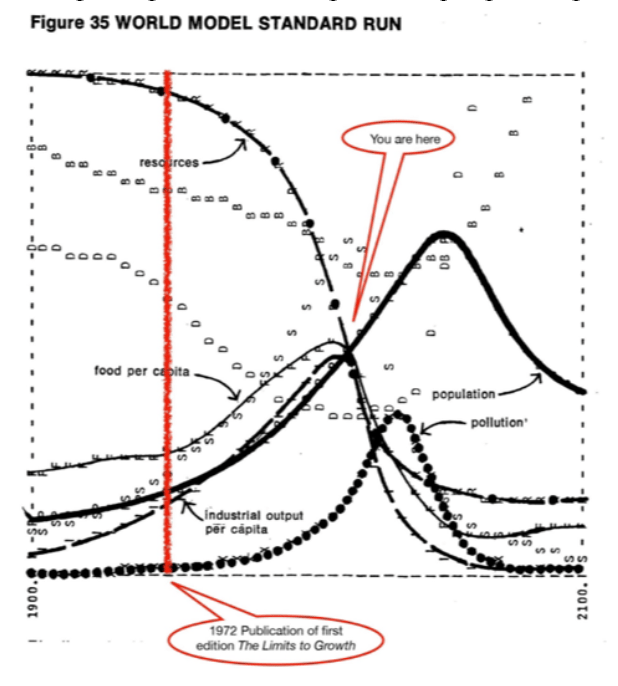
My personal perspective was shaped by the alarming 1968 book The Population Bomb by Paul and Anne Ehrlich. The concern this book raised over fifty years ago led some to become sterilized to not add to the expanding human population. This was followed by the 1972 book The Limits to Growth produced by a group commissioned by The Club of Rome (Meadows et al). Using the concepts of system dynamics developed at MIT they laid out a variety of scenarios for what might happen in the future, what the world might look like in 2000. The report was heavily criticized.
Their 1992 book Beyond the Limits pointed out that the global industrial system had already overshot some of the planet’s ecological limits and that there could be collapse by the middle of the 21st century unless sweeping systematic changes were made. The thirty year update to the original book sounded alarms about climate, water quality and other threatened resources. The fifty year update is on the web where the original book can be downloaded. The business as usual scenario has mostly been followed since 1972 depicted in the figure from the original book. There B is the crude birth rate, D the crude death rate and S services per capita in dollar equivalent per person per year.
Books followed with titles: “Degrowth: A Vocabulary for a New Era”, “Prosperity without Growth: Economics for a Finite Planet” and “Limits and Beyond: 50 years on from The
Limits to Growth, what did we learn and what’s next?” There is limited discussion of these ideas today.
An important perspective recognizes that global warming and other serious issues are symptoms of having gone beyond the limits of growth rather than specific problems to be tackled. Other symptoms are wars, pandemics and water scarcity. The requirement is to find ways of limiting growth on a finite planet in its various forms and begin the process of seeking well-being without growth. Without our doing so other more catastrophic forces will stop growth. Our efforts to reign in global warming without addressing continued growth are bound to fail. But again, there is next to no discussion about this.
Something else caught attention in the 1960s, namely observing Earth, a finite planet, from space. This became the theme for the Whole Earth Catalogue and their subsequent publications. The concept of space colonies was born then. We could colonize space when we outgrew the earth’s capacity. Although quiescent for years, SpaceX and other entrepreneurial ventures now are beginning to present such possibilities.
Donella Meadows, the lead author of the 1972 Limits to Growth presented an important perspective on how to change systems in a winter 1997 issue of Whole Earth Review. Search for the title: Places to intervene in a system (in increasing order of effectiveness) to download it. It has been cited over 3300 times!
These places are ordered here and will be the subject for a later blog:
9. Numbers (subsidies, taxes, standards)
8. Material stocks and flows
7. Regulating negative feedback loops
6. Driving positive feedback loops
5. Information flows
4. The rules of the system (incentives, punishment, constraints)
3. The power of self-organization
2. The goals of the system
1. The mindset or paradigm out of which the goals, rules, feedback structure arise
In a later publication containing much detail she added
0. The Power to Transcend Paradigms.
With the planetary health crisis that has been the defining feature of this weekly, where do we stand? I do not believe that technology, such as solar, wind and other forms of power generation, can save us without tackling underlying growth. Jeff Gibbs in his video, Planet of the Humans presents this as does the book Bright Green Lies. An academic treatment can be downloaded as well.
COP 28 and other efforts at seeking renewable energy are not taking us away from fossil fuels anytime soon. W. Edwards Deming said “Every system is perfectly designed to get the results it gets.” Changing the system is our challenge. The results of the current system are becoming more obvious by the day.
Paul Ehrlich today voices the human carrying capacity on Earth to be around a billion. We are far beyond that. Humanitarian efforts will try to address those starving and deprived of so much. But without tackling the fundamental limit of the planet to sustain us, future generations will pay a colossal price.
 PLANETARY HEALTH WEEKLY