BEZ’S BLOG #20: “Cliodynamics: A Theory of Human History”
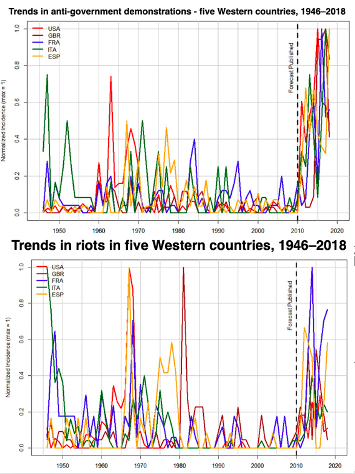 |
| Credit: Turchin and Korotayev, 2020 One way to confuse people is to use fancy words that are unfamiliar. That is much of what constitutes the educational process of becoming a medical doctor. Consequently, I learned about 5000 new words to bewilder people and make them think I was smart! On the other hand if you are developing a new way of thinking and analyzing something perhaps a new term is useful. The slogan ‘population health’ comes to mind. When I first imported the phrase from the University of British Columbia to the University of Washington in 1997 as the title of a guest lecture by Professor Hertzman’s, I was told to ask him to change it as the expression was unfamiliar. He refused and now speaking of population health is commonplace at least in some circles. Cliodynamics is constructed from clio, the Greek mythological muse of history, and dynamics, the study of motion. Peter Turchin coined the term to represent his scientific attempt to study human history. Let me sketch the elements of his models grounded in human history in the hope that it could be used to make predictions. After all what is science but constructing a theory that allows predictions that can be verified or discredited. Einstein’s General Theory of Relativity predicted the gravitational red shift which was later observed, confirming his theory. Various scientists in the late 19th Century were positing germ theory, finally observed and published by Louis Pasteur in 1861. Cliodynamics looks at complex human societies, states, which appear to have recurrent, somewhat predictable waves of political peace and harmony interrupted by outbreaks of internal warfare and discord. States form and then collapse. Every society to date has seen a rise and fall. The Persian, Roman and British Empires as well as Russia and subsequently the former Soviet Union come to mind. Consider a model of history where a state has stagnating or declining real wages (adjusted for inflation), a growing gap between rich and poor, the overproduction of young people with advanced education/degrees, together with declining public trust and exploding public debt, alongside increasing misery amongst the people (termed immiseration) it experiences a time when these are all related to one another dynamically. Using the United States as an example, these factors came into being in the 1970s. My learning began with the banking crisis of 2007-8 when I discovered that worker wages, which had been rising along with productivity, stagnated around 1970 while productivity continued to increase. This process produced a wealth pump, with about 50 trillion dollars being transferred from the bottom 90% to the top 1% of Americans (mentioned in June’s Blog #18). More students graduated from college than before and the production of advanced degrees such as PhDs resulted in most of them not being able to find the academic jobs they prepared for. There has been a huge increase in the production of lawyers per capita, tripling since the 1970s. Starting salaries for the 2010 class are mostly in the $40 to $60 thousand range but a few elite start at three times that. This is an example of elite overproduction leading to intra-elite conflict which cliodyanmics shows is a reliable predictor of a looming crisis. In the healthcare sector we have a vast over-production of specialists and few primary care doctors or generalists. We can agree that America is today in a crisis. Some consider the January 6, 2021 storming of the Capitol a sign of the age of discord, laying the grounds for a civil war. Mass shootings are so commonplace that they no longer make headlines. There is huge political polarization together with ways to distract people from what is going on by ‘divide and conquer’ strategies such as a focus on pronouns and gender orientation, while reproductive rights are swept away, and the public has become immizerated. We even have the dissociation of weight gain from eating with new drugs. The immiseration is clear with declining life expectancy in the U.S. and increasing deaths of despair. The country consumes 80% of the world’s opioids in an attempt to cope with its staggering wealth inequality which leads to huge numbers of overdose deaths. Will this country continue its health decline as Russia did after the 1991 breakup of the USSR? Where this will end in the short-term is unclear but eventually the state will collapse as all do. Peter Turchin’s book: End Times: Elites, counter-elites, and the path of political disintegration, featured in the the Planetary Health Weekly on July 29 presents these ideas in a highly readable form with mathematical modelling usually relegated to research papers. Turchin argues that the U.S. has gone through two revolutions, the Civil War (1860-65) and the New Deal, the progressive political agenda that began at the beginning of the 20th century and that grew out of the first gilded age. That wealth pump led to the 1929 stock market crash. Legislation giving workers labor-organizing power, high taxes on the rich, social security, jobs for White workers and then the pulling together for World War II led to a social democracy. America could then be considered a quasi-Nordic country as there was strong cooperation between business, labor and government. There followed the Great Compression where the poorest fifth of Americans saw the biggest increase in incomes. In the early 1950s U.S. life expectancy was in league with the longest lived nations. The rising tide lifted all the White boats. The elites worked to undo this progress pushing a neoliberal agenda beginning in the late 1970s, with a focus on decreasing regulations and the power/influence of government. Their political power resulted in the richest 400 families paying the lowest rate of combined federal, state and local taxes by 2018 (mentioned in Blog #18). Elite overproduction led to severe competition amongst them. Examples include large numbers of candidates vying for the presidential election in 2016 and 2020. Today the U.S. is a plutocracy with rule by the rich. Where are we headed now? The approaching crisis is like a metal ball constrained by rolling down a steep-walled valley. Once it reaches the valley’s mouth, the cusp, there are many possible routes. One nudge could lead to more benign outcomes while another could lead to a catastrophic collapse. Turchin’s multipath forecasting models this process. He was asked to contribute to the Feb 4, 2010 issue of Nature, one of the world’s leading scientific journals, on what the next decade might look like. He predicted growing instability in the U.S. and Western Europe. The two graphs above by Turchin and Korotayev published in 2020 looked at anti-government demonstrations and riots in five Western countries (U.S. Great Britain, France, Italy and Spain) from 1946 to 2018. They show how the theory can predict future events. What we expect from a scientific theory are predictions that can be verified or rejected, just as happened with Einstein’s General Theory of Relativity and Pasteur’s microbiological explanations. The world is awash today with most of us do-gooders tinkering at small points on the edges of the steep walled valley. Turchin compels us to see the big picture and give a big push at the end of the steep-walled gorge into the direction of planetary and human society stability. What might that force be? What would it take for the counter-elites, those frustrated elite-wannabes seen in the riots and anti-government demonstrations, to return to do the massive organizational efforts of almost a century ago that turned off the wealth pump? That might just push us in the direction of sustainability. Stay tuned. Stephen Bezruchka, Seattle, WA |
 PLANETARY HEALTH WEEKLY