MILNER ON BIODIVERSITY BLOG #13: “COLLAGEN”
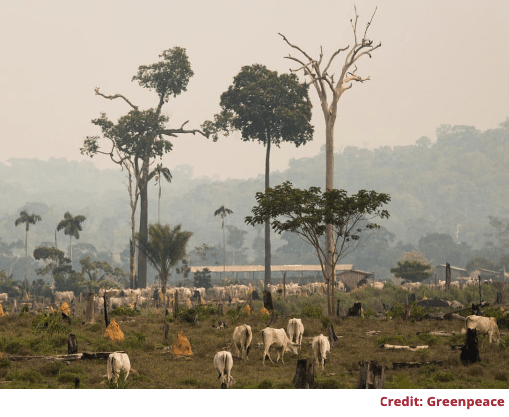
| Collagen, in powdered form is one of the developed world’s most popular health supplements – a business worth an estimated $4.7 billion in 2022. Recommended by several leading lifestyle influencers a daily dose is claimed to work wonders for hair, skin, nails and joints. In addition, due to its ‘excellent blending properties and ‘smooth flowability’ it is increasingly used as a component of what are known as ‘processed food products’. A major issue arises though as much of the supply of commercial collagen is produced from the hides of cattle raised on newly cleared land in Brazil. Investigators have shown it is inextricably linked to deforestation, biodiversity loss, land invasions and violence against indigenous peoples. Collagen seems to be a classic product of late-stage capitalism – so profitable it excites the greed of the biggest multinationals yet so damaging to the environment that details of its production have to be veiled in secrecy, as they involve unacceptable damage to both people and nature. Too often all this is hidden under the catch-all ‘commercially sensitive’ label. Like palm oil (multiple uses) and coltan (raw material for mobile phones), collagen is a contradictory product providing for (Western) humanity’s present desires at a planetary cost that is increasingly problematic. One of the leading companies involved in the collagen trade is Vital Proteins Inc. a subsidiary of the giant Nestlé Corporation, one of the world’s biggest food producers – and one of the most unprincipled multinational corporations on the planet. Nestlé has been involved in major scandals for decades involving misleading baby milk advertising and recycling claims, unethical food sources etc. According to analysts CBInsights Nestlé would like you to believe they have left all this disreputable behaviour behind as they now claim to be ‘prioritising health and sustainability across their portfolio.’ Look a bit closer and you see that this admirable objective is an aim in the context of their ‘growth strategy’. In other words sustainability comes second to maximising profit, and as they admit on their own website ‘preserving natural capital becomes increasingly crucial …for the future of our business.’ But meanwhile they continue to ignore this warning. Vital Proteins also claims the moral high ground with a commitment to ‘doing business in a way that respects people and the planet’. But not just yet, it would seem. Following the exposé of their Brazilian supply chain by the Bureau of Environmental Investigations they admit they won’t be ‘deforestation free’ until 2025. Meanwhile forest clearance and attacks on indigenous people continue. This is about as cynical as greenwashing gets: it means ‘we intend to behave properly but in the meantime, we are making too much money to be bothered’. Since presumably they were aware of their own supply chain before being exposed, their ‘way of doing business’ may be a form of words of fairly recent origin. Vital Proteins certainly seem like a perfect fit for Nestlé. My question is, why is it that big corporations can’t find reputable ways of doing business instead of being unscrupulous, destructive and dishonest, all kept secret and denied until revealed by activists and journalists? And then, instead of changing policy they go on to try silencing the investigators or even question their motives. Greenwashing seems to be ingrained in the corporate mindset. A major trend in recent years is the move towards ESG (Environmental, Social and Governance) disclosure, as a way of claiming compliance with growing international standards. Some of these standards, especially those to do with biodiversity are ill-defined, and while the basic morality underpinning a whole enterprise or its methods go unquestioned, the value of this exercise is unclear. The ESG claims of companies like Purdue Pharma, Smith & Wesson, Johnson & Johnson are all first rate, yet all three have had to pay out billions due to what courts found were ‘irresponsible marketing’ strategies leading to tragedies great and small. As some of the ESG rating agencies admit, the disclosure process is aimed at reassuring investors, not at changing corporate behaviour. Whatever its value the whole ESG movement is gaining momentum internationally, notwithstanding the ridicule of right-wing commentators such as the Wall St. Journal, who regard the whole process as a distraction from the main purpose of business – to maximise profit. But should profitability be the sole purpose of business, whatever the cost to others and the environment? When management of the giant Swedish timber corporation STORA found out that clear-felling (their preferred harvesting method) was extremely damaging to the overall forest ecosystem, they decided that the entire company needed a changed mindset – even if it meant their profits were reduced. If their business was based on the forest, then the health of the forest was their responsibility – not a concept that big business seems too familiar with – and company policy should reflect that. Basic classes in forest ecology were provided for all staff, and a fresh approach to their entire business was introduced; the enhancement of their extensive forest holdings was to be the primary objective. As a result, harvesting methods were changed, replanting schemes redesigned and detailed forest monitoring established – and all this was done not to satisfy some inspectorate, or to raise their ESG profile, but because it became part of the philosophy of the company. What they soon realised was that they could still produce timber and enhance the biodiversity of the forest at the same time; it wasn’t difficult, but it just needed a new way of thinking, a new set of priorities. The company’s standing improved and staff recruitment became competitive. Short-term profitability had been sacrificed for long term benefit. Quite a turnaround for a company regarded previously as operating primarily at the low value end of the timber business. The natural state of the planet is deteriorating fast and scientists warn that critical tipping points are being rapidly approached. Deforestation of the Amazon is still accelerating – according to INPE, Brazil’s satellite research agency. If big business is ever to take climate change and the conservation of biodiversity seriously it will only happen with a STORA-style upgrade in the prevailing philosophy, the corporate mission. It is not enough to claim good ESG results, or to increase overall profitability, if dubious practices in core activities and the supply chain persist. Any company, and especially giant multinationals like Nestlé or their subsidiaries, should not feel free to make money at any cost. If respect for Earth and its people are not taken into account, public relations froth like Vital Proteins’ canard ‘our way of doing business’ gains unquestioning acceptance and humanity sleepwalks towards disaster. One way forward is the independent certification of actual performance; this has been pioneered by voluntary bodies such as the Forest Stewardship Council (wood products) and the Marine Stewardship Council (seafood), while the Soil Association certifies organic produce. All three have come in for some criticism; they tend to certify the products of big corporations and a means of certifying artisanal (small-scale) production is still in the planning stage largely due to cost. However, these bodies are helping define appropriate standards for different industries where care of the environment is a primary concern and not to be ignored in the pursuit of profit. Many large companies object to paying for independent certification, at the same time limiting their disclosure of ESG due to ‘commercial sensitivity’. The sort of complete rethink that STORA achieved seems to be beyond the ambition of most large corporations, while the bottom line and today’s share price occupy their overwhelming attention. In the meantime, if you want to purchase collagen powder, I suggest you look carefully for a product which causes no deforestation, violence or corruption – now and not at some unlikely pledged date in the future. Such products are available – you just have to ask for them. Edward Milner, London, UK |
 PLANETARY HEALTH WEEKLY